

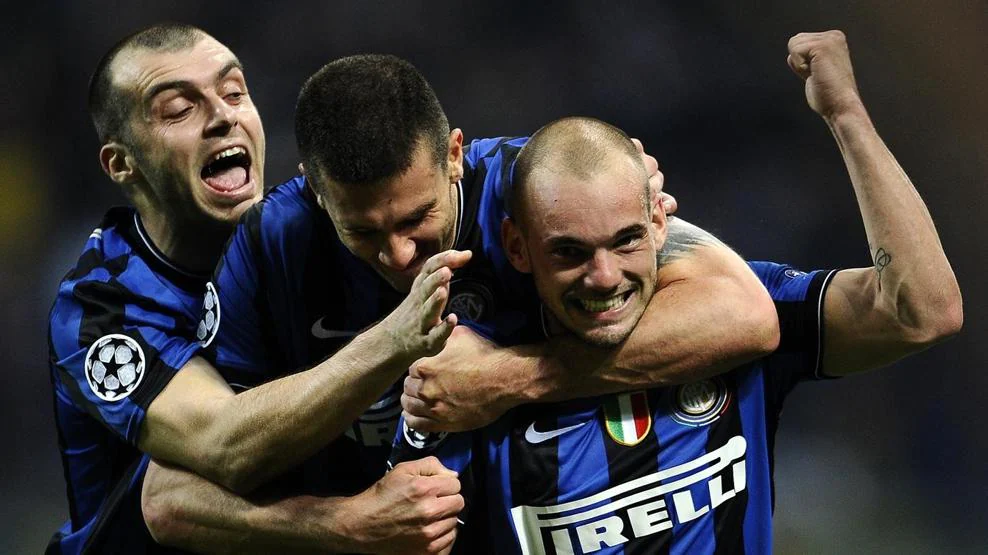
⛈️ The Night the Juggernaut Stalled: Inter’s Blueprint Against Barcelona
The memory of April 20, 2010, still holds immense weight in European football history as a defining moment in the cronología de inter milan contra fc barcelona. Inter Milan hosted FC Barcelona in the UEFA Champions League semifinal first leg that night under perfect football conditions – a clear evening with temperatures at 18°C. Yet beneath the calm surface, the tactical climate was electric.
Barcelona arrived as the undisputed superpower of their era, their revolutionary tiki-taka football making them seem nearly invincible. This crucial chapter in the cronología de inter milan contra fc barcelona saw Inter, under José Mourinho’s masterful guidance, facing not just a football match but the weight of history itself. The stage was set for what would become one of the most tactical and memorable encounters in the storied cronología de inter milan contra fc barcelona.
The final score was shocking to many observers. Inter secured a massive 3-1 victory over the reigning champions. This outcome was no accident of fortune. Instead, it represented a triumph of meticulous planning. The sequence of events—the cronología de inter milan contra fc barcelona—demonstrates a perfectly executed anti-football strategy. This result laid the essential groundwork for Inter’s monumental treble success that season.
🕰️ Previous Encounter: Anticipating the Possession Vortex
For José Mourinho, preparing for Barcelona meant preparing for an entity, not just a team. Their possession style was the known quantity. This specific tactical clash was the “previous encounter” that defined the preparation. Barcelona’s ambition was always total ball dominance. They aimed to suffocate opponents through overwhelming possession. Inter knew they could not compete with that talent on those terms.
The early moments confirmed Inter’s calculated concession of territory. Mourinho designed his team to operate entirely within the danger zones. Inter accepted that they would spend the evening without the ball. Their focus was defensive spacing. They wanted to shut down the crucial passing lanes that Xavi and Messi typically exploited.
The opening phase of the match immediately showed the mental edge Mourinho sought to establish. Just twelve minutes into the game, Samuel Eto’o received a yellow card. This aggressive early foul set a tone. It showed Inter would make every pass and every move uncomfortable for Barcelona. Inter’s strategy was clearly defined: concede the ball, but control the space.
📊 Overall Performance: Efficiency Triumphs Over Volume
The raw statistics from the night show a massive disparity in control. This illustrates the fundamental difference in team ambition. Barcelona sought volume and territory. Inter prioritized clinical efficiency.
Barcelona dominated possession for almost the entire match. They finished with a staggering 67% total possession. Conversely, Inter was left with just 33% possession. This disparity highlights Inter’s willingness to sit deep and absorb pressure.
However, Inter converted their limited opportunities with lethal precision. Inter registered 11 total shots but scored three times. Barcelona managed more shots, logging 17 total shots. Yet, they only scored a single goal. Inter’s defense was also highly effective. Júlio César, the Inter keeper, made 6 saves throughout the match. Víctor Valdés, the Barcelona keeper, only needed to make 4 saves. This meant Inter’s defense was under severe pressure.
The aggressive nature of Inter’s defense is further illustrated by the foul count. Inter committed 27 total fouls during the match. Barcelona suffered 27 fouls, confirming Inter’s success in disrupting their passing rhythm. Inter willingly slowed the game down. They successfully forced Barcelona into making rushed decisions.
| Statistical Comparison | Internazionale | FC Barcelona | Insight |
|---|---|---|---|
| Total Possession | 33% | 67% | Inter conceded territory as part of the plan. |
| Total Shots | 11 | 17 | Barcelona attacked with higher volume. |
| Goals Scored | 3 | 1 | Inter’s finishing was clinical. |
| Shots on Target | 5 | 7 | Inter scored 3 goals from 5 shots on target. |
| Saves Made | 6 | 4 | Júlio César faced constant danger. |
| Fouls Committed | 27 | 21 | Inter used aggression to disrupt passing. |
🌊 Recent Form: The Crucial Timing of the Goals
The mood of the match swung wildly based on Inter’s ability to respond to pressure. The quick timing of the goals became the most critical factor.
Barcelona took the expected early lead. Pedro Rodríguez scored at the 19th minute,. This goal threatened to destabilize Inter’s careful plans. The momentum swung heavily toward the visitors.
However, Inter’s immediate response was decisive. Just eleven minutes later, Wesley Sneijder equalized at the 30th minute,. This goal was not just a score. It was an essential psychological lifeline. It ensured Inter went into halftime level. They managed this despite Barcelona holding 64% of the possession in that first half.
The second half began with Inter seizing the emotional momentum. Maicon scored Inter’s second goal at the 48th minute,. This fast strike immediately after the break shocked Barcelona. It exposed their high defensive line before they could establish their rhythm.
Inter then secured the victory with the third goal. Diego Milito scored at the 61st minute,. This sequence of goals—30′, 48′, 61’—demonstrated Inter’s superior in-game momentum management. It crushed Barcelona’s resolve.
Mourinho managed the game perfectly after securing the 3-1 lead. He began resting key players. Goran Pandev was substituted for Dejan Stanković at the 56th minute. Maicon, who scored the second goal, was taken off for Cristian Chivu at the 73rd minute. Finally, goal-scorer Diego Milito was replaced by Mario Balotelli at the 75th minute. These substitutions showed Mourinho’s confidence. He was already planning for the return leg.
➡️ Main Trends: Defensive Layers and Minimal Waste
The dominant trends of the game highlight Inter’s tactical discipline. They excelled in defense and avoided wasting chances.
Inter’s successful execution of the defensive block meant Barcelona was repeatedly pushed to the flanks. Barcelona managed 7 shots on target, but Júlio César was equal to 6 of them,. Inter’s defense showed incredible commitment. They logged 24 blocks and tackles,. This relentless pressure meant Barcelona could rarely find a clear path to goal.
The contrast in efficiency is stark. Inter scored three goals from five shots on target. Barcelona scored once from seven shots on target. This clinical trend explains the final score. Inter simply did not waste their opportunities.
The match was incredibly hard-fought. This is evident in the discipline record. Inter received four bookings (Eto’o, Sneijder, Maicon, Stanković). Barcelona also received four bookings (Busquets, Piqué, Puyol, Daniel Alves),. This confirms the intense, physical nature of the confrontation. The emotional stakes were high.
📋 Probable Lineups: The Defensive Block vs. The Possession Machine
The starting formations demonstrated the clear tactical divide. Mourinho opted for a solid, resilient structure designed to frustrate the visitor.
Internazionale: The Compact 4-3-3 Hybrid
Mourinho deployed a disciplined setup designed to frustrate the visitors. The starting lineup focused on central solidity and pace on the wings for transitions.
| Position | Player Name | Key Role |
|---|---|---|
| Goalkeeper | Júlio César | Made 6 crucial saves under constant pressure. |
| Defenders | Zanetti, Lucio, Samuel, Maicon | Maicon’s attacking thrust was vital (scored 48′),. |
| Midfielders | Cambiasso, Sneijder, Thiago Motta, Pandev, Stanković | Sneijder provided the creative link (scored 30′),. |
| Forward | Diego Milito | Finished chances with clinical efficiency (scored 61′),. |
| Coach | José Mourinho | Masterminded the defensive block. |
FC Barcelona: The Possession 4-3-3
Guardiola used his standard high-pressing, possession-focused structure. Their immense talent was clear, but the structure was vulnerable to pace.
| Position | Player Name | Key Role |
|---|---|---|
| Goalkeeper | Víctor Valdés | Faced relatively few direct shots on target. |
| Defenders | Daniel Alves, Piqué, Puyol, Maxwell | High defensive line was repeatedly exposed. |
| Midfielders | Xavi Hernández, Busquets, Keita | Dominated possession but struggled to penetrate. |
| Forward | Messi, Ibrahimović, Pedro Rodríguez | Pedro scored the opening goal (19′),. |
| Coach | Josep Guardiola | Sought total control through possession. |
💥 Prediction: A Triumph of Efficiency
The final result of the match was Inter 3, Barcelona 1. The match flow perfectly demonstrated Mourinho’s successful strategy.
The game started with Barcelona asserting dominance. They controlled 64% possession in the first half. However, Inter’s ability to respond quickly was key. They equalized before the break at 30 minutes.
The turning point was the second half. Inter secured the lead just three minutes after halftime (48′). They cemented the victory at 61′. This sequence of goals highlighted the effectiveness of their transition game. The half-time score was 1-1. The final score was 3-1. This confirms Inter’s relentless ability to convert moments into goals. The victory was a tactical masterclass.
👑 Key Players to Watch: The Decisive Moments
The success of Inter’s plan rested on the shoulders of specific, clinical individuals.
Diego Milito (Inter)
Milito was the epitome of efficiency. He scored the decisive third goal at the 61st minute,. His intelligent movement was crucial. It constantly forced Piqué and Puyol out of their comfort zone. He was substituted at 75 minutes, having already completed his essential task.
Wesley Sneijder (Inter)
Sneijder was the creative brain. His equalizing goal at 30 minutes was vital,. It immediately erased Barcelona’s advantage. His passing ensured that when Inter won the ball, the transition was swift and accurate. He was the vital link that turned defense into lethal attack.
Júlio César (Inter, Goalkeeper)
Júlio César was the defensive hero. He was constantly under pressure due to Barcelona’s 67% possession. He made 6 crucial saves throughout the match. His reliability ensured that Barcelona’s numerous, frustrated shots did not alter the scoreline. His performance provided the stability needed for the attackers to operate efficiently.
The match remains a classic reminder. Even total control of the ball cannot guarantee victory against a perfectly organized, mentally resolute opponent. Inter’s 3-1 win was a defining statement of the 2009–10 season.

Leave a Reply