


💔 The Unbearable Anguish of Statistical Defeat
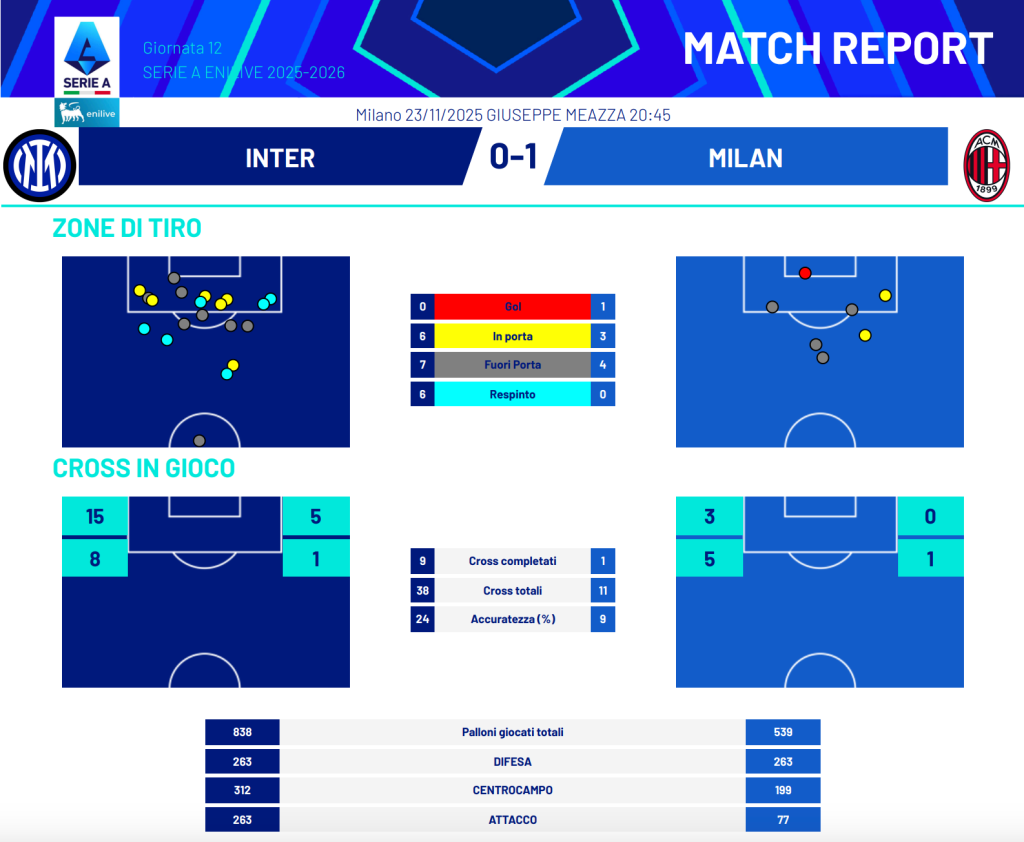
The scene at the Stadio Giuseppe Meazza was agonizing for Inter supporters. This massive Derby della Madonnina clash ended in shock. The date was November 23, 2025. Inter Milan lost 0-1 to rivals AC Milan. This defeat was deeply embarrassing for the league leaders. The scoreline told only part of the story. Furthermore, the underlying data revealed a severe tactical failure. Inter was statistically dominant in every key area. They failed to convert their overwhelming control into goals. Therefore, this predicament raises a crucial question. Why did Inter struggle so badly to score? The answer lies partly in a single missing player. The absence of Denzel Dumfries was heavily felt on the right flank.
Inter’s statistical control was immense. They logged 60% possession against Milan’s 40%. They registered 20 total shots compared to Milan’s 7. Inter created 14 key passes while Milan managed only 4. Inter even earned nine corners while Milan only had one. Despite this domination, Milan scored the decisive goal at 45+2 minutes. Inter could not respond. Consequently, the lack of balance, particularly on the right side of the attack, became painfully obvious.
⚙️ The Tactical Vacuum: Inter’s Right Flank Problem
Inter usually relies on a structured 3-5-2 formation. This system demands immense contribution from the wide players. The wing-backs provide both defense and critical width in attack. Federico Dimarco is the primary threat on the left side. Conversely, Denzel Dumfries typically provides that crucial service on the right. Dumfries was not available for this crucial match. Therefore, his absence created a significant tactical vacuum.
The starting Inter lineup did not feature a natural, high-impact right wing-back. Instead, Inter’s starting eleven included Alessandro Bastoni, Manuel Akanji, and Francesco Acerbi in defense. Carlos Augusto played alongside Barella and Sučić in the midfield. While Carlos Augusto and Dimarco are listed in the starting lineup, Carlos Augusto usually plays on the left. He was forced into an uncomfortable role, or the team’s structure shifted severely. Consequently, Inter’s attacking structure became fundamentally unbalanced.
The Problem of Predictability
The imbalance caused a critical predictability issue. Inter was forced to rely almost entirely on the left flank for width.
- Dimarco’s Burden: Federico Dimarco was clearly Inter’s main source of width. He attempted a huge 12 crosses during the game. He ranked first among all players for crosses. His delivery was essential.
- The Right-Side Silence: The right flank, Dumfries’ usual domain, failed to produce similar output. Milan’s right wing-back, Alexis Saelemaekers, managed only 4 crosses. The lack of a dedicated, high-motor player on Inter’s right meant Milan’s defense could easily anticipate the attack.
- Cross Failure: Inter attempted a total of 38 crosses during the match. However, they only completed 9 crosses, resulting in a low 24% accuracy. Since the attack was concentrated on one side, Milan’s defenders, like Tomori and Gabbia, could position themselves easily. They successfully neutralized Inter’s attempts to find Lautaro Martínez and Marcus Thuram centrally.
This failure to achieve balance was evident in the final third. Inter managed 177 successful passes in the final third. However, the attacking actions were predictable. Milan’s defense could afford to shift centrally or focus on double-teaming Dimarco. The lack of a threat on the right meant Milan’s defense did not have to worry about equal pressure on both flanks. This simplified Milan’s defensive job immensely.
🛡️ Dumfries’ Missing Contribution: The Right-Side Solution
Dumfries is a specialist right wing-back. He is tailor-made for Inter’s 3-5-2 system. Therefore, his presence would have solved several key problems for Inter.
Providing True Width and Stretching the Defense
Dumfries’ primary role is running the entire right flank. He provides constant, energetic movement. If Dumfries had been playing, he would have forced Milan’s left-sided defense (likely Davide Bartesaghi and Strahinja Pavlović) to stay wide. This action would have stretched Milan’s defensive three.
Stretching the defense creates vital space centrally. This space is essential for players like Nicolò Barella and Petar Sučić to operate. It also gives Lautaro Martínez and Marcus Thuram more room to receive the ball and turn. Inter’s average possession stood at 60%. However, this possession was often sterile because the attack lacked necessary width. Dumfries offers the high-speed overlaps that transform slow build-up into dangerous transition play.
Balancing the Cross Attack
Dumfries’ presence would have immediately balanced the crossing statistics. Inter’s reliance on Dimarco became obvious. Dumfries averages high successful crosses (Cross Riusciti). His ability to deliver balls from the right would have given Inter a dual threat.
Milan’s defense prepared for a left-sided assault. If Dumfries was on the field, Milan would have needed to split their resources. This division of focus would improve Inter’s crossing accuracy (24% completed crosses is very low). Furthermore, it would offer more unpredictable angles for the central strikers to attack the goal.
Attacking Transition and Speed
Dumfries is known for his physical capability. He logged 11 appearances before this game. He contributes to both attack and defense. Inter’s core problem was turning possession into clear, unexpected chances. Dumfries excels in this transition phase.
The game statistics show Inter’s reliance on passing (90% success rate). Conversely, Milan excelled in transition, scoring their goal from open play right before halftime. Dumfries’ pace and directness would have increased Inter’s overall danger from quick breaks. His absence left the right side reliant on less dynamic defensive players. This meant Inter lost a crucial element of speed on the flank.
💥 The Cost of Failure: Statistical Dominance Yields Zero
Inter’s embarrassing predicament is best illustrated by the sheer scale of their wasted dominance. They utterly controlled the match dynamics. Nevertheless, they walked away with a devastating loss.
A Barrage of Wasted Chances
Inter fired off 20 shots in total. This contrasts sharply with Milan’s seven shots. Inter managed 6 shots on target, compared to Milan’s three. Milan goalkeeper Mike Maignan made 6 crucial saves. Maignan’s performance was outstanding. However, Maignan was able to face mostly predictable attacks.
The most damning statistic is the lack of precision. Inter’s failure to create higher-quality chances forced them into low-percentage shots. The 24% crossing accuracy tells a clear story. When the crosses finally came, they were often inaccurate. The central strikers, Martínez and Thuram, could not find space. Martínez was substituted at 65 minutes. This change confirms Inter’s mounting frustration in the attack.
| Statistic (Inter vs Milan) | Inter Total | Milan Total | Inter Rank (Serie A) | Insight |
|---|---|---|---|---|
| Final Score | 0 | 1 | N/A | Inter failed to score despite control. |
| Total Shots | 20 | 7 | 1st (307 total) | Extreme dominance in volume. |
| Shots on Target | 6 | 3 | 1st (60 total) | Conversion rate was disastrously low. |
| Possession (%) | 60% | 40% | 1st (overall) | Control did not translate to threat. |
| Key Passes | 14 | 4 | 1st (13.45 avg) | Inter created far more chances. |
| Corners | 9 | 1 | 1st (80 total) | Attack was unrelenting, but narrow. |
| Cross Accuracy (%) | 24% | 9% | Low | Failed to utilize width effectively. |
Centralization and Defensive Ease
The right flank’s deficiency forced Inter to funnel play centrally or exclusively down the left. This made Milan’s defense more comfortable. Milan played a 3-5-2 as well. Their defensive structure (Tomori, Gabbia, Pavlović) remained compact.
Milan’s central midfielders, Modrić, Fofana, and Rabiot, did not have to worry about excessive width. They successfully congested the middle of the pitch. Consequently, Inter’s attempts to use key passes through the center were easily blocked. Milan’s recovery rate was high. They logged 51 successful recoveries, compared to Inter’s 45. This ability to successfully contain Inter’s central play confirms the lack of pressure from the wide areas.
💡 The Final Verdict: A System Dependent on Specialists
Inter’s 0-1 loss in the Derby della Madonnina was a profound disappointment. It was an “embarrassing predicament” because they controlled every statistical measure. The core problem was a structural defect. The 3-5-2 system is highly dependent on both wing-backs functioning optimally.
The absence of Denzel Dumfries broke this necessary symmetry. His presence would have normalized the right flank’s contribution. It would have forced Milan to stretch their defense. This action would have opened space for Inter’s dominant central players. Dumfries would have provided the high-volume crosses and pace needed to surprise Milan.
Without Dumfries, Inter’s attack became predictable. They funnelled play down the left, allowing Milan to defend in comfort. Milan needed only seven shots to win. Inter needed twenty shots and still lost. The 0-1 scoreline is a harsh reminder. Even the best statistical teams fail when key specialists, like Dumfries on the right flank, are missing from a delicate tactical system. The defeat highlights the vulnerability of Inter’s strategy when their specialized wing-back personnel is compromised.

Leave a Reply