


Do You Think That Wesley Sneijder Should Have Won the 2010 Ballon d’Or?
“Some years create a winner.
2010 created a debate — and its name was Wesley Sneijder.”
There are football years when greatness is so overwhelming that the identity of the Ballon d’Or winner feels inevitable: Messi in 2012, Ronaldo in 2017, Modrić in 2018.
And then there is 2010 — a year where the trophy was awarded, but the conclusion has never quite settled.
Lionel Messi was crowned the best player in the world.
Yet an enormous part of the football community still looks back at that season and whispers — or sometimes shouts — that Wesley Sneijder had a stronger claim than anyone.
This is not a revisionist take; it’s a reflection shaped by performance, context, competitive difficulty, and narrative weight. And in 2010, Sneijder’s story was simply more complete.
The question is not whether Messi was extraordinary — he always is.
The question is whether Sneijder, in that unique football year, was more decisive.
Let’s explore that.
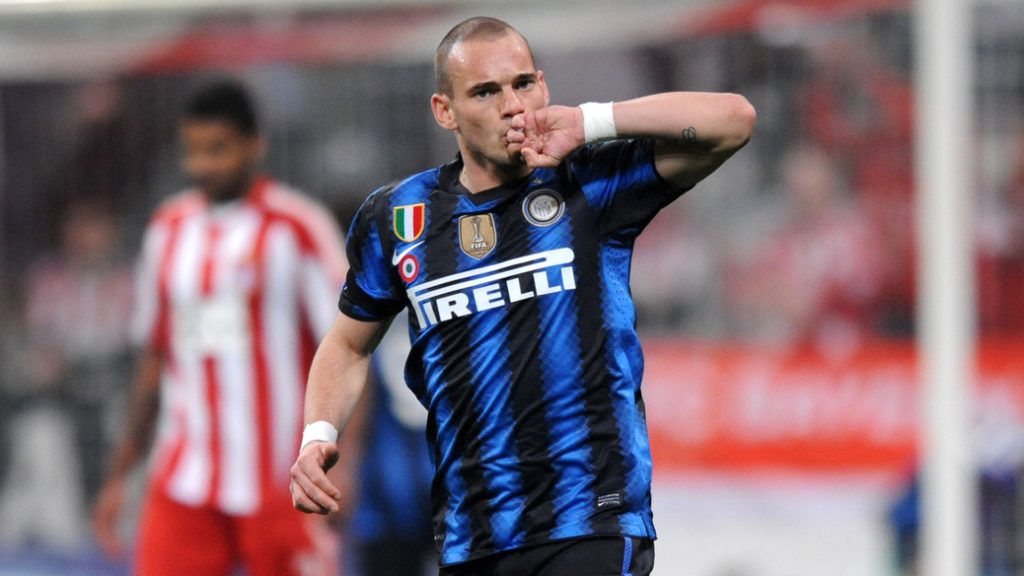
The Year of Wesley Sneijder — A Story Written Everywhere
2010 wasn’t the story of one competition.
It was the story of every competition, all conquered by the same player orchestrating them from midfield.
Sneijder did something extraordinarily rare: he became the creative heartbeat of a team that won a Treble, while also carrying his national team to the World Cup Final.
Few seasons in history combine that level of club dominance and international influence.
Below is a table summarizing his most important numbers:
Sneijder’s 2010 Competitive Output
| Category | Wesley Sneijder (2010 Season) |
|---|---|
| Champions League | 6 assists, 3 goals, decisive KO-round contributions |
| Serie A | Title winner, 8 assists, 4 goals |
| Coppa Italia | Winner, 1 goal, multiple MOTM displays |
| World Cup 2010 | 5 goals, 1 assist, Silver Ball candidate |
| Major Trophies | 3 with Inter + World Cup Finalist |
| Awards | UEFA Midfielder of the Year, multiple MVP recognitions |
Treble winner + World Cup finalist in the same year is perhaps the single strongest Ballon d’Or résumé ever assembled.
The Champions League: The Birthplace of His Claim
Inter Milan’s 2009–10 Champions League run remains one of the most tactically respected campaigns in the modern era.
José Mourinho’s compact, cynical, and perfectly executed structure was powerful — but it required a single player to be the connective tissue, the rhythmic center, the visionary spark.
That player was Sneijder.
He orchestrated transitions, disguised passes between the lines, pulled markers out of position, and delivered in the biggest moments:
• Assisted both goals in the round of 16 vs. Chelsea
• Scored and assisted against CSKA Moscow
• Scored and created in the semifinal vs. Barcelona
• Provided the decisive assist in the final for Diego Milito
If “value” is measured by a player’s impact on outcomes, Sneijder’s Champions League run was near-perfect.
He wasn’t merely part of the Treble — he was the architecture of it.
The World Cup: Where the Myth Became Real
Sneijder’s transformation at the 2010 World Cup was stunning.
While he was the cerebral orchestrator at Inter, he became the primary goalscorer for the Netherlands — in a tournament defined by defense, attrition, and narrow margins.
5 goals from midfield.
Not tap-ins.
Not deflections.
But tournament-shifting goals:
- The volley vs. Brazil
- The decisive shot that eliminated Slovakia
- The winner vs. Japan
- The dramatic header against Brazil
- The goal that broke Uruguay in the semifinal
There is no universe in which the Netherlands reach the Final without Sneijder.
He did not float around the edges of matches — he rewrote them.
The Ballon d’Or Philosophy: Should It Reward the Best or the Most Decisive?
This is where the real debate lies.
Because if the Ballon d’Or is purely about talent, Messi is untouchable.
But if it is about:
- impact,
- decisiveness,
- a calendar-year narrative,
- and the rarity of accomplishments,
then Wesley Sneijder has arguably the most compelling claim of any player who has not won the award.
2010 is the perfect storm where all these arguments converge.
Where Messi excelled individually, Sneijder defined the success of entire teams — club and country.
Messi vs. Sneijder — A Fair Comparison?
Some argue the comparison should not be made because Messi is a generational anomaly.
But that’s exactly why Sneijder’s case matters.
Messi was brilliant in 2010.
But Barcelona were eliminated in the Champions League semifinal.
Argentina were eliminated in the World Cup quarterfinals.
Sneijder maximized every competition.
The question is not whether Messi was better — he probably was.
It’s whether Sneijder’s season was more deserving of the award.
Awards are not lifetime achievement trophies.
They are moments in time.
And Sneijder’s moment was greater.
Narrative Power: Why Sneijder’s 2010 Still Echoes Today
Football awards live inside narratives.
Mourinho once said:
“Without Sneijder, there is no Treble.”
This is not merely a compliment.
It is an acknowledgment of a footballing truth: Inter’s historic season was architected through Sneijder’s brain and boots.
In the World Cup, Sneijder was the centerpiece of a team that shocked Brazil, cracked Uruguay, and pushed Spain to the brink in the Final.
Messi’s story in 2010 wasn’t as complete.
He was brilliant — but brilliance without payoff.
Sneijder’s was both brilliant and complete.
Why Sneijder Didn’t Win — And Why Many Still Disagree
Several structural issues worked against him:
1. The merger of France Football and FIFA awards created voting distortion
Coaches and national-team captains began favoring global star reputations.
2. Creative midfielders are historically undervalued
Especially those who appear subtle rather than explosive.
3. Inter’s style wasn’t glamorous
They were tactical, defensive, and grounded in discipline.
The Ballon d’Or tends to reward aesthetics as much as results.
4. Timing bias
The voting momentum always favored Messi and Ronaldo during this era.
These factors don’t invalidate Messi’s victory — they simply explain why Sneijder’s case grew louder over time, not quieter.
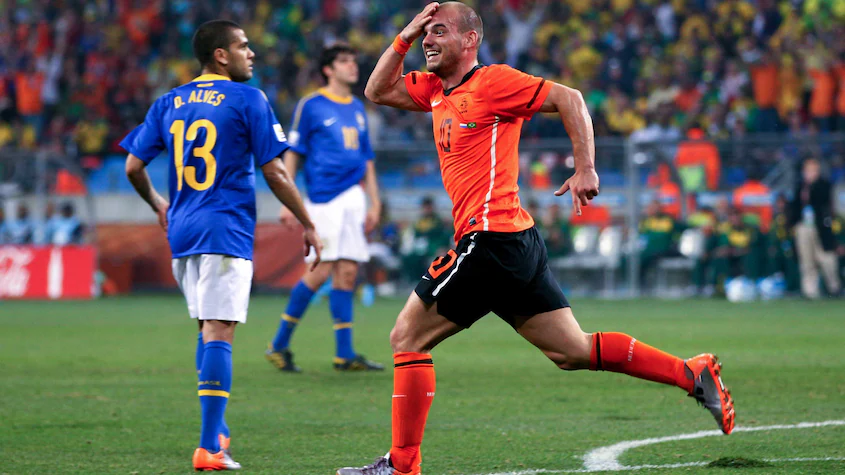
The Legacy of “The Almost Ballon d’Or”
Not winning the award doesn’t diminish Sneijder’s impact.
In some ways, it elevates it.
The debates continue.
Fans still argue his case passionately.
Analysts still cite his 2010 season when discussing award injustice.
There are players who win trophies.
And there are players whose seasons become reference points.
Sneijder belongs to the second category.
His 2010 season is not just remembered — it is felt.
So… Should Sneijder Have Won It?
Yes.
Not because Messi was undeserving.
Not because the award was flawed.
But because what Sneijder accomplished in 2010 is almost never accomplished at all.
- A Treble as the creative brain
- A World Cup Final as the best player
- Decisive contribution in every major knockout match
- Goals, assists, leadership, tactical intelligence
- A historic, narrative-rich season that shaped two continents of football
If the Ballon d’Or is meant to honor the player who defined the year, Sneijder was the definition of football in 2010.
Final Thoughts
Awards are snapshots.
Legacies are stories.
And some stories grow stronger with time.
Wesley Sneijder’s 2010 season has aged like a legend — because it was one.
Whether or not the Ballon d’Or recognized it, football history has.

Leave a Reply